Tuesday, December 4, 2018

New Translations


GAZING AT GREAT MOUNT TAI


What can we tell of the mountain god?
Creation distilled its beauty there.
Its green height commands both Qi and Lu.
Its mass cleaves day into dawn and dark.
As returning birds heave into sight
breathless climbers meet layered clouds.
I should myself climb to the summit
to see at once other mountains as hills.
     --Du Fu


NIGHT AT THE WESTERN OUTPOST


The evening of the year--day hurries off.                                 

Fallen snow at World's End--night clear and cold.               

Sad drums and bugles announce the fifth watch.                     

The River of Stars track the Three Gorges.                              

Families wail, hearing of new battles.                                      

Fishers and woodsmen sing barbarian songs.                           

Ancient statesmen and tyrants, now yellow dust.                     

No peace, no letters--sadness to no end.                                   

     --Du Fu


*********************************************************************************


Ci are Chinese poems written as lyrics to pre-existing tunes.  The same tune may have accumulated multiple ci by various authors.  As with most Chinese poetry, the lines are end-stopped, but the lines are irregular in length, that is, irregular in the number of syllables to fit the tunes to which they are written. Except for their names and the particular patterns of their line lengths along with some other specified prosodic elements, these tunes have all been lost.  Sort of romantic to think about--words for lost songs.

To construct my versions of these poems, I have used Fifty Songs from the Yuan by Richard F. S. Yang and Charles R. Metzger.  This book has been very valuable for my purposes.  It gives the ci in their original characters, in alphabetic transliteration, in a word-for-word translation, then as a "first draft," and finally as a literary version in English.

These final literary versions are, to my mind, constructed on very odd principles.  I follow Douglas Hofstadter in believing that in doing translation, one must choose which aspects of the original to attempt to hold steady and which to let slip.  Yang and Metzger made the choice to hold to the original syllable length of each line, and, when necessary, to let pretty much everything else slip.
Semantic content is omitted here and added there, sometimes resulting in a poem quite different in meaning from the what the Chinese poet wrote.  Not only are lines not end-stopped, they are often broken with no regard for English syntax.  What they call their first draft is almost always truer to the original, and, not infrequently, a better poem in English than their polished final version.

By the way, the Yuan Dynasty was the Mongol Dynasty.  The first Yuan emperor was Kublai Khan, the emperor when Marco Polo arrived in China.


A WIFE'S LATE SPRING SONG


Red, blowing in the wind,
the fallen tung flowers.
Light fog, a willow deep in the courtyard.
Idle by the small window,
stopping my embroidery.
Layers of screens and curtains
breached by dreams of mutual longing.
     --Li Chiyuan
     --tune:  Welcome to the Immortal Guest


[UNTITLED]


Qu's Encountering Sorrow,
who but the sun and moon
can fathom its deepest meaning?
Sadness lingers,
but the man is gone,
present only in the happiness
of fish, shrimp, and crabs
in the Xiang River.
That man's sins,
what are they
in the shadow of the green mountain?
Drink madness and sing pain,
find happiness without limit.
     --Chang Yanghao
     --tune:  Happiness to the Wide World


Yang and Metzger note that Qu Yuan, author of a famous poem, "Encountering Sorrow," was slandered at the court of a late-Zhou king and banished despite his loyal service.  Despairing, he drowned himself.


LOTUS SONG I


The lotus picker and his lotus song
pass the willows in an orchid boat,
heedless of breaking my dream
of lovers as mandarin ducks.
And how was the night?
Who climbed the river tower and lay down?
However heartbroken, don't sing
old songs of the southern dynasties.
The Records of the Grand Historian
already holds so many tears.
     --Yang Guo
     --tune:  Little Red Peach


LOTUS SONG II


Lotus-gathering boats, gone from the lake.
Gentle wind, green silk gown.
One pipa tune, many lines of tears.
As I hope for your return,
mimosas bloom and fade without news--
and this evening's so cold.
Red ducks, white cranes,
don't they always fly in pairs?
     --Yang Guo
     --tune:  Little Red Peach


A NEW LIFE


Since leaping from the fire pit of merit and fame,
coming to this faerie land of flowers and moonlight,
keeping these fields of good land,
watching for a while rain plowing, smoke tilling,
my heart is no longer turbulent
and every night I sleep till dawn.
Seeing Xiechuan village, chickens and dogs at peace,
green smoke rising from mulberries and hemp that ring the house.
Holding my cane, there's nowhere I can't walk.
With my eyes full of cloudy hills, my painting's never finished.
The sounds of new spring--listening with care.
Returning to the thorn gate and feeling quiet.
     --Chang Yanghao
     --tunes:  The Twelfth Month, The Song of the People of Yao


Yang and Metzger say that Xiechuan, a small village, was once visited by Tao Qian, perhaps the greatest of the pre-Tang poets, and that Xiechuan is usually associated with peace and quiet. Actually, the whole poem follows pretty closely the outline of a well-known poem by Tao Qian:


Returning to My Country Home, No. 1


From the first, I was unsuited to society,
but I had a natural love of hills and valleys.
Still, I fell into the snare of the world.
One little slip and thirteen years were gone.
Birds in cages love their old forests.
Fish in ponds still miss their home waters.
Tilling the south field at the edge of the wild,
still just a rustic, I've returned to my farm.
Around my house are ten or so acres,
dotted with the thatch of eight or nine huts.
Elm and willow overhang the back eaves.
Peach and plum lead away from the front hall.
A distant village is faint in the haze.
Thin smoke curls from the abandoned hamlet.
A dog barks from deep in the lane.
A cock crows in the mulberry tree.
This shuttered house, still free of the dust of the world,
its empty rooms full of time and quiet.
After so long, long in a cage,
I can at last get back to nature.
     --my tr.


[UNTITLED]


Heart-break places:
remnant sunset at the edge of heaven,
clouds at the edge of the sea.
A goose sleeps by a withered lotus.
Crows perch in distant trees.
Fallen leaves thick on jagged rocks.
Bamboo sways across the silken window.
Evening comes on:
Sadness grows under the pestle grinding the mortar.
Lamentation enters the lute.
     --Bo Pu (a ci from the song chain "Tears from the Boudoir")
     --tune:  Mud River Dragon


[UNTITLED]


My house by Parrot Island,
home to an illiterate fisherman
in a shallow boat among the waves.
Sleeping through the smoky rain on the south river.
Waking with eyes full of green mountains.
Returning, I shake my green grass raincoat.
So I was wrong to rage at heaven,
which has made a place for me.
     --Bai Ben
     --tune:  Parrot Song


SADNESS IN SPRING


Morning dreams are clouds.
A little rouge remains.
A little bit of tender heart hates him
for ten years without a letter to say sorry,
by the bank of the green river,
in the spring of blue grasses,
in the village of red apricots.
     --Zhang Kejiu
     --tune:  Four Pieces of Jade


AUTUMN:  A Song Chain by Ma Zhiyuan


1.
A hundred years in a butterfly's dream.
Look back and lament the past.
Spring comes today.
Flowers fade tomorrow.
The night's deep. The lamp's out.  Down three cups of wine.
Alt: Guzzle wine deep into darkness then snuf out the light.
     --tune:  Running a Boat at Night

I'm very tempted to go with "Pound three cups of wine."  I generally try to avoid slang that would wrongly place a line chronologically or geographically and use instead more or less neutral literary diction.  But the literal translation is, "Hurriedly punish cups."  I'll decide after I pound a few beers.


2.
Recall the palaces of Qin and Han.
All come down to grass, fields of cows and sheep.
No wonder
fishermen and woodsmen are wordless.
Tombs stand in wilderness.
Monuments lie broken.
Who can tell dragons from snakes?
     --tune:  Evergreen Tree Song


3.
Thrown into fox paths and hare caves,
how many heroes?
Strong legs, the tripod, but broken at the waist.
Wei-Jin?
     --tune:  Celebrating the Yuan He


I'm not sure that I really understand this part.  I include it only to make the whole chain of ci complete.  The tripod was an common form for ancient Chinese pots, often with three stubby, hollow, pointed legs that are of a piece with the body of the pot.  Looking at some picture, I could see perhaps that the pot above the small legs could be construed as lower body missing the part above the waist.  


4.
So Heaven makes you rich--
don't be profligate.
Good days and fine nights aren't forever.
Rich families' sons,
your hearts more and like iron,
wind and moon missing from your painted halls.
     --tune:  Plum-Falling Wind


5.
Before me again, the red sun slanting west,
fast as a downhill carriage.
Not resisting the mirror that holds more snow white hair.
Going to bed, departing my shoes.
Don't laugh at the owl's ungainly nest.
Muddled, I'd been playing dumb.
     --tune:  Wind Entering the Pines 


6.
Profit and name are gone.
Right and wrong have come to nothing.
No one kicks up red dust at my front gate.
A green tree roofs the corner of the room.
Blue mountains fill the cracks at the top of the wall.
And there is a bamboo fence and a grass hut.
     --tune:  Plucking Can't Harm It


7.
Crickets chirp through a long, peaceful sleep.
Roosters crow--the ten thousand things go on and on.
Will there be a year when this will end?
Look:  ants massing, arraying themselves for battle,
bees frantically brewing honey,
flies desperately fighting for blood.
In Lord Bei's Green Field Hall,
in Magistrate Dao's White Lotus Lodge,
I love the things of the coming autumn:
with dew, picking the yellow flowers,
with frost, parceling out the purple crabs.
Warm the wine over burning red leaves.
Think of the shallow cup of our lives--
how many autumn festivals can we enjoy?
If anyone asks after me, remember my boy,
should Beihai himself come to visit,
tell him that Dungli is already drunk.
     --tune:  Feast at the Departing Pavilion


Beihai was a person of the late Han dynasty known for his hospitality, particularly for the food and drink he provided.  Dungli was the courtesy name of the author Ma Zhiyuan.  A courtesy name was taken or given at the age of twenty as a sign of adulthood.


My source for constructing my English versions of these connected ci has again been Fifty Songs from the Yuan by Richard F. S. Yang and Charles R. Metzger.


SAD WIVES AND COURTESANS:  A Chain of Ci by Bai Pu


1.
Take out the golden hairpins.
The jade capital guest has gone.
In carefree autumn
evenings pass in pleasant idleness.
Needle and thread are put away.
The perilous tower leans alone
beyond the twelve-pearl screen.
The wind is stiff and cold.
Rain ends and sky clears.
Filling my eyes, mountains appear as if newly painted.
     --tune:  Paint the Red Lips

The meaning of "jade" here is something like "exceedingly fine," as it often is in Chinese poetry.  In the fourth ci below, "jade" is jade.  


2.
Heart-break places:
remnant sunset at the edge of heaven,
clouds at the edge of the sea.
A goose sleeps by a withered lotus.
Crows perch in distant trees.
Fallen leaves thicken on jagged rocks.
Bamboo sways across the silken window.
Evening comes on:
Sadness grows under the pestle grinding the mortar.
Lamentation enters the lute.


     --tune:  Mud River Dragon


3.
Recalling him, crazy impulsive, beyond now the edge of heaven.
How would he know what's muttered about him here,
with his singing whip and the drunken shakes, sitting a clever new horse?
Please don't drink the Green Tower's wine
or the Xie family's tea.
Don't you remember our words when we held hands at Linqi?
     --tune:  Window-Penetrating Moon


4.
A long time leaning on the banister.
Returning to the embroidered boudoir.
Descending the dangerous tower.  Coming loose, a gold lotus shoe.
Deep courtyard, silent red gate.
Standing on the mossy terrace.  The chill penetrating thin stockings.
Counting days till his return, painting with a short jade hairpin.
Wiping away tears, wetting the scented silk kerchief.
     --tune:  Parasitic Grass


5.
Since the wild goose letters stopped,
so many divinations by tortoise shell.
Eyebrows, however freshly drawn, locked in goodbye sadness,
jade features paling.
From one festival to the next,
no arrival home.
     --tune:  The Yuanhe Song

"Wild goose letters" are letters eagerly awaited.  Sometimes there is a particular person who is the wild goose carrying the letters.  The ancient Chinese practiced divination by reading the cracks in a tortoise shell exposed to fire.


6.
So few happy meetings.
So much sorrow.
Feelings confused as tangled hemp.
Wandering down to the east fence.
Sighing, sorry for myself.
So clear, so cold, a yellow flower facing the moon.
     --tune:  Charm While Mounting the Horse


SAD PARTING Tune: Four Pieces of Jade Unbearable since you left, the weight of two hearts. When will they stop throbbing? Leaning on the railing. Sleeves brushing away willow flower snow. Out of sight beyond the hill, the river winds away. --Kuan Han-ch'ing

Saturday, March 5, 2016

A Selection Of Classical Chinese Poems--My Translations to English


ANONYMOUS


Number 14 of the 19 Music Bureau Poems

Gone and daily receding,
coming and daily more near.
Looking straight out the city gate:
mounds and hills, mounds and hills.
Ancient graves are plowed into fields.
Pine and cypress destroyed for kindling.
Winds of sorrow out of white poplars.
The swishing sound of the axe men.
Dwelling on returning home--
no track, no trace of a road.
No way there from this longing.


The Spring Song of Lady Night

The spring woods
hold flowers of great beauty.
The spring birds
cause thoughts of great grief.
The spring breeze has also great feeling,
blowing open
my gauzy silk skirt.
     --300-600 C.E.


    Autumn Song of Lady Night
Opening the window
to the autumn moon,
she puts out the candle,
slipping off her silk skirt.

And suppressing a smile
within the curtained bed,
she arches her body,
spreading orchid fragrance


TAO QIAN


RETURNING TO MY COUNTRY HOME, NO. 1


From the first, I was unsuited to society,
but I had a natural love of hills and valleys.
Still, I fell into the snare of the world.
One little slip and thirteen years were gone.
Birds in cages love their old forests.
Fish in ponds still miss their home waters.
Tilling the south field at the edge of the wild,
still just a rustic, I've returned to my farm.
Around my house are ten or so acres,
dotted with the thatch of eight or nine huts.
Elm and willow overhang the back eaves.
Peach and plum lead away from the front hall.
A distant village is faint in the haze.
Thin smoke curls from the abandoned hamlet.
A dog barks from deep in the lane.
A cock crows in the mulberry tree.
This house is still free of the dust of the world,
its empty rooms full of time and quiet.
After so long, long in a cage,
I can at last get back to nature.
 
Alt.:  This shuttered house, free of the dust of the world,
         its empty rooms full of time and quiet.


An alternative translation:


From the first, I was unsuited to society,
but I had a natural love of hills and valleys.
Still, I fell into the snare of the world--
one little slip and half my life was gone.
Birds in cages love their old forests.
Fish in ponds still miss their home waters.
Clearing the south field at the edge of the wild,
still just a rustic, I've returned to my farm.
My two or three acres surround the house,
its thatched roof over eight or nine rooms.
Elm and willow overhang the back eaves.
Peach and plum lead away from the front hall.
A distant village is faint in the haze.
Thin smoke curls from unseen huts.
A dog barks from deep in the lane.
A cock crows in the mulberry tree.
This shuttered house, free of the dust of the world,
its empty rooms full of time and quiet.
After so long, long in a cage,
I can at last get back to nature.


Since I wrote my first version of this poem, I've come upon more information about it has made me question of the accuracy of some aspects of the translation.  Most particularly, I've read Arthur Sze's commentary on the piece in Into English, edited by Martha Collins and Kevin Prufer, a gift from my son, Conor, and his wife, Alexis.


DRINKING WINE #5


Though I've made my house among men,
there is no noise of horse and cart.
You may wonder how this can be--
as mind's detached, place is distant.
Picking mums at the eastern hedge,
catching sight of the southern hills.
The mountain air, fine in the fading day.
The returning birds, flying together.
In all of this, there is truth and meaning,
the words for which I forget as they form.
     --Tao Qian


WANG WEI


 The Tang Dynasty poet Wang Wei and his friend Pei Di wrote a series of paired quatrains about twenty sites on Wang's estate near the Wang River.  This "wang" is a different word, written with a different character, than the poet's name. Sometimes it's translated "Wheel River," which seems rather an odd name for a river.  I did come across a note that "wang" means "wheel" by virtue of its root meaning of "turn."  So perhaps a better translation would be "Swirling River" or "Winding River."
     I would like to make my version of all of these forty poems.  I don't know Chinese, so I work mostly from literal translations and commentary.  The majority of Wang's contributions are pretty readily available in some form I can work on.  But those of Pei Di, the less-celebrated poet, are quite scarce. So I haven't tried working on Pei Di yet. In the original Chinese that follows each of my translations, I have included Pei Di's quatrain as well as Wang Wei's. I had literal translations for all of Wang Wei's poems except for numbers 4, 14, 15, 19, and 20.  For all these, I had at least four literary translations and some commentary to work from.  All of my translations are provisional in the sense that I am open to reworking them if I become aware of inaccuracies or misinterpretations.  And this is doubly so for those five poems.
     The collection begins with Wang Wei's own preface.


THE WANG RIVER POEMS


My country retreat is in the Wang River mountain valley.  There are places for pleasant walks such as Meng Wall, Huazi Hill, White Bamboo Hill, a deer fence, Magnolia Enclosure, a cornel grove, Scholar Tree Path, the lake pavilion, South Hill, Lake Yi, Willow Waves, a rill by the house of the Luans, Gold Dust Spring, White Stone Rapids, North Hill, a bamboo grove, Xinyi Village, the lacquer tree grove, and the pepper garden.


1.
MENG WALL


My new house near the Meng Wall gate.
Ancient willows absorbed in grief.
Who will be the next new owner,
sorrowing over past inhabitants?
     --WW


孟城坳

王維:新家孟城口,古木馀衰柳。來者複爲誰,空悲昔人有。
裴迪:結廬古城下,時登古城上。古城非疇昔,今人自來往。


The house that was built under the old wall--
sometimes 


     The house newly acquired by Wang Wei had formerly belong to the poet Sung Chih-wen, who died in 712 when Wang Wei was twelve or thirteen.  


2.
HUAZI RIDGE


Once more, endless flights of departing birds
and autumn coloring hill after hill.
All up and down Huazi Ridge
sadness spreads without limit.


華子岡

王維:飛鳥去不窮,連山複秋色。上下華子岡,惆悵情何極。
裴迪:落日松風起,還家草露晞。雲光侵履蹟,山翠拂人衣。 


3.
HOUSE OF GRAINY APRICOT WOOD


Beams cut from apricot wood.
Roof woven with fragrant reeds.
Do clouds beneath the ridgepole
float off to rain upon men?


杏館

王維:文杏裁爲梁,香茅結爲宇。不知棟里雲,去作人間雨。
裴迪:迢迢文杏館,躋攀日已屢。南嶺與北湖,前看複回顧。 


4.
WHITE BAMBOO HILL


Tall Bamboo, empty river bend,
green image on rippling water.
Enter the hidden Shang Hill path
even woodcutters do not know.


斤竹嶺

王維:檀欒映空曲,青翠漾漣漪。暗入商山路,樵人不可知。
裴迪:明流紆且直,綠筱密複深。一徑通山路,行歌望舊岑。


     Both G.W. Robinson and Pauline Yu state that this poem refers to the "Four Whiteheads," who retired as hermits to Mt. Shang in Shaanxi province rather than serve in the government of the first Qin emperor when he came to power in 221 B.C. 


5.
DEER PARK


Empty mountain.
Seeing no one.
Hearing someone's
echoing voice.
The late day sun
enters again
the deep forest,
shining once more
on the green moss.


鹿柴

王維:空山不見人,但聞人語響。返景入深林,複照青苔上。 
裴迪:日夕見寒山,便爲獨往客。不知深林事,但有麏麚蹟。


      Most commentators think that "empty mountain" refers to the Buddhist concept of emptiness as well as to the absence of people.  Of course, this is a quatrain in the original just like the others.  I just found a structure that worked very well in English.  Violations of the Chinese prosody are inevitable in the transference to English. This one is just more obvious.  I'm pretty sure that it's accurate semantically. This poem is probably the most translated in the Chinese canon.  Here are several other translations for comparison. http://www.chinapage.com/poem/wangwei/wangwei-trs.html


6.
MAGNOLIA ENCLOSURE


Autumn hills gather waning light.
Back and forth, birds chase through the air.
All things green are suddenly bright.
At sunset, mists are here, then there. 


木蘭柴

王維:秋山斂馀照,飛鳥逐前侶。彩翠時分明,夕嵐無處所。
裴迪:蒼蒼落日時,鳥聲亂溪水。緣溪路轉深,幽興何時已。 


7.
CORNEL GROVE


Their berries are both red and green
as if the trees were blooming still.
Should a guest linger on the hill,
set out a cup of cornel wine.


茱萸沜

王維:結實紅且綠,複如花更開。山中儻留客,置此芙蓉杯。 
裴迪:飄香亂椒桂,布葉間檀欒。雲日雖回照,森沉猶自寒。 


     I found this poem confusing in both the literal and literary translations that I found, so I did a little research on what a cornel might be.  Some translations have "dogwood" in both the title and last line, some "cornel" in both, and some "dogwood" in one place and "cornel" in the other.  Sometimes "dogwood" and "cornel" seem to be referring to the same thing and sometimes a cornel seems to be some structure that is part of a dogwood tree. I found that the genus name for all species of dogwood is "cornus," and so a dogwood tree can also be called a cornel.  The fruits of the dogwood are sometimes called cornelian cherries.  One problem was that initially I found references to only American, European, and West Asian dogwoods.  But eventually I found a discussion of an East Asian dogwood, "cornus kousa."  It flowers throughout the summer and produces a sweet red berry that can be made into wine.
     With this information, then, I thought I could make sense of the poem.  Because the tree blooms over a long period, it would naturally have red and green--ripe and unripe--fruit and pretty flowers all at the same time. Following on this notion, at first I wanted to translate the second line "and still the trees are flowering," but every source I've found agrees that there's something in the second line that should be translated "as if."  So perhaps it more likely means that the berries make the tree so colorful that it looks from a distance like it were still flowering.  Which is why I settled on "as if the trees were blooming still."  Looking at other versions, I have a feeling that the translators weren't really sure what "dogwood cup" or "cornel cup" in the original Chinese should mean.  My best guess is that it refers to a cup of cornelian cherry wine.  So for clarity in my own cultural context I added the word "wine" which is not there explicitly in the Chinese.


8.
SCHOLAR TREE PATH


Through scholar trees, a dim, narrow path,
the dark, mossy way to the temple.
Sweep the entrance and wait by the gate
in case a monk comes down from the hill.


宮槐陌

王維:仄徑蔭宮槐,幽陰多綠苔。應門但迎掃,畏有山僧來。
裴迪:門前宮槐陌,是向欹湖道。秋來山雨多,落葉無人掃。 


     The word here translated as "temple" seems actually to mean "palace."  Whether there is a recognized secondary meaning "temple" I don't know.  Some translators see it that way and it certainly makes more sense as far as I can see.  It is not explicit in the original whether the palace/temple is at the bottom or top of the hill.  I believe the most likely interpretation is that there is some kind of residence at the base of a hill and a path that leads up the hill to a temple--and that is the reading that informs my translation.  I don't think it likely that any structure on Wang's estate would be called a palace.  His own dwelling is presumably the grandest and is generally referred to in translation as "house" or "villa."  If there is a temple at the top of a hill, it's more plausible that one might be on the lookout for a monk to come down.  


9.
THE LAKE PAVILION


A small boat to greet honored guests.
Slowly coming across the lake.
At the railing with cups of wine.
Lotus flowers blooming all around.


臨湖亭

王維:輕舸迎上客,悠悠湖上來。當軒對尊酒,四面芙蓉開。 
裴迪:當軒彌滉漾,孤月正裴回。穀口猿聲發,風傳入戶來。 


10.
SOUTH HILL


On a light boat, going out from South Hill.
To North Hill, hard to cross the wide water.
On the distant shore, people and houses.
So far off, I can't know if I know them.


南垞

王維:輕舟南垞去,北垞淼難即。隔浦望人家,遙遙不相識。
裴迪:孤舟信一泊,南垞湖水岸。落日下崦嵫,清波殊淼漫。 


11.
LAKE YI


Your flute precedes you to the farther shore
as I see you off at sunset.
From the lake you turn your head back
to green mountains and rolling white clouds.


欹湖

王維:吹簫凌極浦,日暮送夫君。湖上一回首,青山卷白雲。 
裴迪:空闊湖水廣,青熒天色同。艤舟一長嘯,四面來清風。 


12.
WILLOW WAVES


Beautiful, these trees standing in rows,
their reflections cast in clear ripples,
and, unlike willows by palace moats,
not grieving their parting in spring wind.


柳浪

王維:分行接綺樹,倒影入清漪。不學禦溝上,春風傷别離。 
裴迪:映池同一色,逐吹散如絲。結陰既得地,何謝陶家時。 


     The custom of giving a willow thread to someone going away was a staple of Chinese poetry.  And, according to G.W. Robinson in his collection of Wang Wei's poems, partings were often depicted as taking place at a palace moat.  My rendering here is another that is especially provisional because I had only several literary translations to compare and so far have been unable to find a word-for-word translation.


13.
RILL BY THE HOUSE OF THE LUANS


Hard wind blows through autumn rain.
Shallow rills flow over rocks.
Water beads splash against each other.
White egret starts, then settles back.


欒家瀨

王維:颯颯秋雨中,淺淺石溜瀉。跳波自相濺,白鷺驚複下。 
裴迪:瀨聲喧極浦,沿涉向南津。泛泛鷗鳧渡,時時欲近人。 


     Perhaps it would be interesting to see the what the literal translations that I work from look like.
The first is by Wai-Lim Yip and the other by Hugh Grigg from his blog, East Asia Student.  I have followed Yip in using "rill" rather than "rapids."  I assume that Yip chooses "rill" to fit better with what he gives as "lightly-lightly" or "shallow-shallow" and Grigg as "trickle trickle," a rill being a small, shallow stream.  For consistency, I think, Yip also changes "waves" to "beads" in his more literary translation.  Hard to imagine waves crashing into each
other on a rill. And to say a wave jumps seems odd--a more natural description of the water splashing up as raindrops hit a small stream.  Probably out of context "rapids" and "waves" are the best translations of the original Chinese, but within the poem, plausible secondary meanings work better.  All that said, now I've come across a translation of the accompanying poem about the same location by Pei Di that refers to a river.  So maybe Mr. Yip and I are all wet.


Rill of the House of the Luans

Blast-blast __ autumn  rain  middle

Lightly-lightly/shallow-shallow __ rock flow pour
Jump wave/s  self  mutual/each other  splash
White  egret  startle  again  down


LUAN FAMILY RAPIDS

swish swish autumn rain in

trickle trickle stone slip slide
jump wave self each-other splash
white egret startle return descend


14.
GOLD DUST SPRING


Drink each day from Gold Dust Spring,
live for more than a thousand years.
Then in the Green Phoenix Car drawn by striped dragons,
go with plumes and tassels to the Jade Emperor.


金屑泉

王維:日飲金屑泉,少當千馀歲。翠鳳翊文螭,羽節朝玉帝。 
裴迪:縈渟澹不流,金碧如可拾。迎晨含素華,獨往事朝汲。 


     A daily drink of powdered gold or jade was supposed to give one health and longevity.  According to G.W. Robinson, the Green Phoenix Car belonged to the mother of the King of the West, one of the Daoist immortals, and the Jade Emperor was the supreme deity in popular Daoism.  The color word here rendered as "green" appears as "azure," "green," or "sky-blue" in other translations.  I think what's going on is that there is a word in Chinese, or at least in the Chinese of this era, that refers to a larger portion of the spectrum than any English color word.  I am myself familiar with an example from one other language:  In Khmer the spectrum is divided into two parts, khiew and krahaam.  Khiew is generally translated as blue, and krahaam as red.  And there are many color words with narrower reference.


15.
WHITE STONE RAPIDS


Clear and shallow, White Stone Rapids.

Green rushes,  just out of sight.
Folks from east and west of the river
washing silk brilliant in moonlight.


白石灘

王維:清淺白石灘,綠蒲向堪把。家住水東西,浣紗明月下。
裴迪:跂石複臨水,弄波情未極。日下川上寒,浮雲澹無色。


     Chinese uses the copula "to be" much less often than English, so that sometimes in a fully grammatical statement there is nothing English speakers would recognize as a verb.  But in resisting the temptation to insert a verb to make the English sentence "complete," one can preserve an element of Chinese prosody and so retain fidelity to the original in two ways.  In five-syllable lines such as make up all these quatrains, it was the rule to have a phrase structure of two syllables then three syllables with a natural pause or "caesura" in between.  Leaving out a linking verb between subject and predicate will often produce a natural pause, which can be represented by a comma as in the first two lines here.  I am unable to produce this effect consistently and it would probably sound odd in English anyway.  When rendered orally, Chinese poems were neither declaimed nor spoken conversationally, but chanted, with the pattern in five-syllable-line poems being da da, da da da/da da, da da da...


16.

NORTH HILL


At North Hill, north of the lake,
a red railing bright between trees.
South River winds through green woods,
flashing in and out of sight.


北垞

王維:北垞湖水北,雜樹映朱闌。逶迤南川水,明滅青林端。 
裴迪:南山北垞下,結宇臨欹湖。每欲采樵去,扁舟出菰蒲。 


There is perhaps a parallel between the railing and the river as continuous things that appear discontinuous.


17.
BAMBOO GROVE


Picking out tunes on my lute,
whistling a bit of something,
I sit here in so much light,
alone and facing the moon.


竹里館

王維:獨坐幽篁里,彈琴複長嘯。深林人不知,明月來相照。 
裴迪:來過竹里館,日與道相親。出入唯山鳥,幽深無世人。 


18.
XINYI VILLAGE


Limbs, branches, hibiscus flowers.
Throughout the hills, their red calyces.
House by the stream, stillness, and no one.
All around, all blooming and falling.


辛夷塢

王維:木末芙蓉花,山中發紅萼。澗戶寂無人,紛紛開且落。 
裴迪:綠堤春草合,王孫自留玩。況有辛夷花,色與芙蓉亂。 


In the first line, translations that I found had either "lotus," "water lily," or "hibiscus."  The first two being water plants, I chose "hibiscus," a flowering tree.  A bit of research found that the hibiscus flower does indeed have deep red calyces.  Calyces are the strips just under the petals that are the split remnants of the casing that encloses a flower before it blooms. However, Pauline Yu says that this poem alludes to a passage in one of the poems in the ancient anthology, The Songs of the South, the hopelessness of meeting a goddess is compared to finding figs in the water or lotuses on trees.  From this perspective, though, I'm not sure how the red calyces--or stems, as sometimes translated--are the right color for either magnolias or lotuses.  Anyway, here's a version of the poem according to the lotus hypothesis:


MAGNOLIA BANK


Trees, branches tipped with lotus flowers.
Throughout the hills, their red calyces.
House by the stream, stillness, and no one.
All around, all blooming and falling.   


19.
LACQUER TREE GROVE


The old sage, not overreaching,
no thought to bestride the world.
Holding just a minor post,
lord of a few swaying trees.


漆園

王維:古人非傲吏,自闕經世務。偶寄一微官,婆娑數株樹。 
裴迪:好閑早成性,果此諧宿諾。今日漆園游,還同莊叟樂。 


The "old sage" here is Zhuangzi, the semi-legendary Daoist philosopher, he of the butterfly dream.  In his companion piece, Pei Di refers to Zhuangzi explicitly.  Although he was mostly a hermit, Zhuangzi at one time was Superintendent of the Lacquer Tree Grove and turned down an offer from the King of Chu to be a minister of state. All of my translations are provisional, in the sense that I am open to reworking them if I become aware of inaccuracies or misinterpretations.  But this one is doubly so, because I have been unable to find a literal translation and worked from several divergent literary translations.


20.

PEPPER GARDEN


Cassia wine to greet the Child of Heaven.

Mallow flowers bestowed on the lovely one.
Pepper-spiced libations on the jeweled mat.
All to draw down the Lord Amid the Clouds. 


首·椒園

王維:桂尊迎帝子,杜若贈佳人。椒漿奠瑤席,欲下雲中君。 
裴迪:丹刺罥人衣,t芳香留過客。幸堪調鼎用,願君垂采摘。


    Thinking about the pepper garden presumably reminded Wang Wei of a reference to pepper sauce or pepper broth in the Nine Songs, a collection of shamans' invocations of the gods included in the ancient anthology "Songs of the South."  And then he included a reference to the Nine Songs in each of the four lines.


**************************************************************************************************************


RETURNING TO MOUNT SONG


Trees flanking the clear stream.
My cart horse ambling on.
Flowing water knows how I feel.
Evening birds come home with me.
Empty town above the old ferry.
Setting sun filling the autumn hills.
Far away from the outside world,
returned to the foot of the mountain.
    --Wang Wei
Alt:  back home at the foot of the mountain.


TAI YI, THE CENTRAL PEAK OF ZHONGNAN MOUNTAIN

Zhongnan near the imperial city:
height upon height right down to the sea.
Look back at white clouds, they're all one.
Enter the green haze, it's all gone.
From the middle peak, the land shapes change.
Sun and shade no valley dapple the same.
Hoping for a human place for the night,
call to that woodsman across the water.


HOUSE AT SOUTH HILL


In middle age, I found the Buddha Way.
In old age, I've settled here at South Hill.
Often on a whim I go walking alone:
small portions of nature known just to me.
I can trek up to the source of a stream
and sit down to see when the clouds will rise.
Sometimes I meet this old man in the woods
and we talk and laugh and forget to leave.


WEI CITY SONG


A morning rain settles the light dust.
Willows by the inn green up again.
Have one more cup of wine here with me.
No old friends will be west of Yang Pass.


SEPARATION SICKNESS


Red berries of the longing tree grow there in the south.
Come the spring, the branches bush out and fill with fruit.
I hope, friend, that you will pick more and more and more
of what is the simple for this illness of ours.


王維
相思

(Red)(Bean)(Born/Grow)(South)(Country)
(Spring)(Come)(Produce)(How Many)(Branch)
(Wish)(You)(Much)(Pluck)(Pick)
(This)(Item/Thing)(Most)(To)(Think)

相思: (combination of these two character means Lovesickness)
     --word for word translation by Laijon Liu


White stones stick up from Bramble Brook.
Red leaves sparse against a cold sky.
No rain now on the mountain path.
My clothes wet from the high green brush.


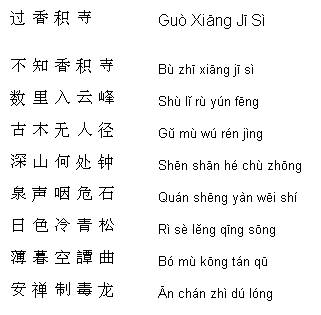
PASSING THE TEMPLE OF TEEMING FRAGRANCE
The Temple of Teeming Fragrance
measureless miles in summit clouds.
Ancient forest, a pathless way.
Deep mountains, directionless bell.
Spring water over jagged rocks.
Yellow sun on cool green pines.
Twilight, winding pool.  Quiet sitting
uncoils the poison dragon of the heart.


Monks make incense at the Temple of Teeming Fragrance.


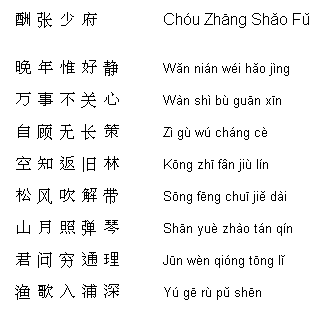
REPLYING TO SUBPREFECT ZHANG

In my old age, I want only peace.
The ten thousand things are not my concern.
I've no plan for the rest of my life
but to come back to this, my ancient woods.
Piney wind blows my girdle open.
Mountain moon lights upon the lute I play.
So where's the warp and weft of the world?
Fishermen's songs come far up the inlet.


SITTING ALONE ON AN AUTUMN NIGHT


Alone, grieving over my graying hair.
In the empty hall, nearly nine o'clock.
Mountain fruit fall in heavy rain.
Grasshoppers sing in my lamplight.
Hair gone white can never go back.
Nothing can change to yellow gold.
Want to cast off age and illness?
You need to study not being born.

Some translators have "no rebirth" in the last line for what is most literally "no-birth."  But I think that with Wang Wei's Buddhism being the Dao-tinged Buddhism of Zen, he wouldn't have been so concerned with reincarnation.  Perhaps the the reference would have been more to the illusion of self, of ego, of something that came into being at a certain time and persisted in its essence all through one's life.  To not hang on to that illusion.


Surely you can say,
having come from my village,
if the winter plum

has blossomed already there
by the patterned silk window.


AUTUMN EVENING, MOUNTAIN LODGE


Empty mountain, just after rain.
Evening air, the air of autumn.
The bright moon shines through the trees.
A clear spring flows over stones.
Bamboo rustles, washer girls return.
Lotus leaves sway, fishing boats glide by.
Sweet grass of spring withers as it will.
Noble friends, of course we should stay!


SONG OF SUFFERING FROM HEAT


Red sun dominates earth and sky.
Fire clouds top off mountain peaks.
Grass and trees are scorched and shriveled.
Rivers and ponds have all gone dry.
Lightest white silk is too heavy.
Densest wood gives too little shade.
Sleeping mats are too hot to use.
Linens are washed and washed again.
Thinking of leaving space and time,
where all is emptiness and void.
Long winds come from ten thousand li.
Great waters wash away dirt and care.
But to see flesh as affliction--
that is the unawakened mind.
Just then the Sweet Dew Gate opens
on clear joy, sinuous and cool.
     --Wang Wei


苦熱 
 
赤日滿天地
火雲成山嶽。
草木盡焦卷
川澤皆竭涸。
輕紈覺衣重
密樹苦陰薄。
莞簟不可近
再三濯。
思出宙外
曠然在寥廓。
長風萬裏來
江海蕩煩濁。
卻顧身為患
始知心未覺。
忽入甘露門

宛然清涼樂。


I have perhaps over-interpreted the next-to-last couplet in the interest of having it say what I think it says.  This is a literal translation from Hugh Grigg's blog East Asian Student:  "yet worry body as contract disease/begin know heart not yet wake up."  Some translations emphasize the notion that the body is the source of suffering and the enlightened mind escapes the flesh.  But Wang Wei was a Buddhist, a Zen Buddhist.  And, as such, would certainly not have denied the flesh can be a source of pain, but suffering--that he would have seen as a matter of mind.  So I think that his seeing that his mind was focused on bodily distress--and on dreaming of escaping it--was his entry into the realization that it was that focus itself that was the source of his suffering.

The "Sweet Dew Gate" is a reference to how the teachings and practice of Buddhism open on enlightenment.  Less poetically, it could be called the "Dharma Gate."

Then in the last two lines there a sudden awakening, a throwing open of that gate.  There are two schools within Zen, one sees enlightenment as achieved incrementally with long study and practice and the other sees enlightenment as coming suddenly, say, by hearing a hoe clatter on a stone--after long study and practice.  Wang Wei's dates are 699-759.  The idea of sudden enlightenment is associated with Huineng, the sixth Zen Patriarch, 638-713CE.  Wang Wei's dates are 699-759.  So the doctrine of sudden enlightenment was relatively new.  Zen arrived in China, where Buddhism in general was already established,  from India with Bodhidharma, the First Patriarch, in the 520's.

A couple more translation notes:  I'm not sure whether the second line means the that the mass of the clouds looks like mountains or that the clouds are above the mountains.  And with the line "Sleeping mats are too hot approach," the general meaning is correct, but I've lost the parallelism with the following line as in Hugh M. Stimson's literal translation, "rush-mat bamboo-mat not can approach/fine-linen coarse-linen again three wash."  I'd like to do better with these two lines, but have so far failed.


Wang Wei was a painter as well.                                                                


LI BAI


TO MENG HAORAN


I love you Meng Fuzi, Master Meng,
free spirit, famous under heaven.
In rosy youth, you spurned cap and carriage.
With snowy head, you lie among clouds and pines,
drunk beneath the moon, remaining the sage,
addled among flowers, serving no lord.
At the foot of your unscaleable heights,
I bow in gathering mountain fragrance.


TO THE FESTIVAL PLATEAU


Feeling oppressed toward evening,
I drive up to this ancient place.
The sun blazes a moment more
before the yellow dusk follows.


Blue mountains to the north of town.
White water to the east of town.
We stop here for a last goodbye:
Thistledown flies a thousand li.
Now you must be a floating cloud,
and your old friend, the setting sun.
Waving, each goes his separate way.
Parting horses nicker and neigh.


送友人

青山橫北郭, 白水遶東城。
此地一為別, 孤蓬萬里征。
浮雲游子意, 落日故人情。
揮手自茲去, 蕭蕭班馬鳴。


SEEING OFF MENG HAORAN FROM YELLOW CRANE TOWER


As flowers bloom and leaves unfold,
my friend sets out, east for Guanling.
His solitary sail recedes,
vanishing where river meets sky.


TWO VERSIONS OF "JADE STAIRS"


RESENTMENT ON THE JADE STAIRS

Midnight on the stairs of jade,
white dew soaks her silken hose.
Draw down then the crystal shade:
fall's moon glitters in its gems.


STOOD UP ON THE JADE STAIRS

Midnight on the stairs of jade,
white dew soaked your silken hem.
Draw down then the crystal shade:
moonlight glitters in its gems.


HIGH SUMMER

Lazing in the mountain wood,
waving a white feather fan,
I get up, open my clothes,
hang my headband on a rock.
Green pine wind plays through my hair.


WINE WITH THE MOUNTAIN HERMIT

We drink amid the mountain flowers.
A cup, one more, and then another.
I'm in a stupor, you stagger off.
Come back with your lute, when you can.


ALONE IN MY CUPS

Drinking wine, unaware
of nightfall. Fallen flowers
fill the folds of my clothes.
Getting up and walking
to the moonlit river,
where no birds and few men
remain.


SPRING NIGHT:  A FLUTE IN LOYANG


From which house, fleeting, invisible notes
mingling with the wind and fillng the city?
Hearing that tune, A Willow Twig for Parting,
who could not dwell on thoughts of home?


TO MENG HAORAN


I love you Meng Fuzi, Master Meng,
free spirit, famous under heaven.
In rosy youth, you spurned cap and carriage.
With snowy head, you lie among clouds and pines,
drunk beneath the moon, remaining the sage,
addled among flowers, serving no lord.
At the foot of your unscaleable heights.
I bow in gathering mountain fragrance.


Above Censer Peak, sunlight on purple smoke.
The falls, a curtain hanging in the distance,
is a torrent plunging three thousand feet down.
Silver River rolling from highest heaven.


     --Li Bai


DU FU


AT FENGJI STATION:  A SECOND FAREWELL TO YEN WU


Once more we part here after another long ride.

Again, these green hills bring on impotent sorrow.

Will we ever raise wine cups together again

or walk beneath the moon as we did last night?

Everyone sang your praises everywhere we passed:

three reigns you have served at court and far away.

Now I go back alone to my river village

to live my remaining years as best I can


STAYING THE NIGHT AT GENERAL HEADQUARTERS


Clear, cold autumn night by the well and wutong trees.

Alone in River City–candles guttering out.

Muttering sadly–bugles sounding through the night.

Ivory moon rising–but only for me. 

Wind and dust of back-and-forth battles:

No letters, no travellers through desolate passes.

These ten years of tribulations have driven me 

to a perch here on this one peaceful branch.


PAINTED HAWK

  
From blank white silk arise wind and frost– 
a blue hawk, painted in fine detail. 
Its body tenses, spotting a wily hare. 
Its eyes glare like an angry barbarian. 
The bright tether ring tempts your grasp. 
The high perch solicits your call. 
Would the great hawk then attack lesser birds, 
marring the green plain with blood and feathers? 


THOUGHTS OF THE NIGHT TRAVELLER


Slender grass in the shore breeze.
Tall mast on a lonely boat.
Stars sink over spreading fields.
The moon rides on the river.
Too old and sick for office--
and will scribblings make my name?
Drifting, drifting, what am I?
One gull between earth and sky.


Spring Prospect


The nation in ruin,
mountains and rivers remain.
The city in spring,
deep in grass and trees.

Lost in wretched times,
weeping over flowers.
Sunk in loneliness,
startling at birdsong.

Beacon fires,
burning for three months.
Family letters,
worth thousands in gold

I've pulled so at my white hair
that my hatpin barely holds.

Alt:  And I've pulled at my white hair

         till my hatpin barely holds.

        Pulling so at my white hair

        that my hatpin barely holds.


SPRING NIGHT IN THE CHANCELLERY


Flower-shaded palace walls darken further at dusk.

Chirping birds pass by, heading to a perch for the night.

The stars appear, looking down on city and palace.

The moon ascends, shining brighter into the heavens.

Sleepless, I conjure arrivals in the sounds of the wind:

golden keys turning, jade pendants jangling on bridles.

I have a report to give at the dawn audience.

Again and again, I check the progress of the night.


Moonlit Night


Just now, alone in our room,
you gaze at the Fuzhou moon.
Our children--I ache for them
from far away--they don't see
why you brood upon Changan.
Fragrant fog scents your gathered hair.
Lustrous moon chills your slender arms.
When, between the gauzy curtains,
will we lean together again,
these tears dried on our faces,
their traces limned in moonlight?


MEANDERING RIVER


1

Spring diminishes with each falling petal,

countless points of sorrow swirling in the wind.

Soon I will see the last remaining flower

and will then be drinking wine without solace.

Kingfishers nest on a hut by the river.

Unicorns adorn the border of a high tomb.

Looking into nature tells you to seek joy.

So why do I strive for undeserved honor?


2

Daily after court, I pawn some of last season’s clothes.

And then, stinking drunk, I stumble home from the river.

An unpaid tab, I’ve got one in most all the taverns.

Since ancient times, almost no one’s made it to seventy.

Butterflies weave deeply into the bank of flowers.

Dragonflies dawdle and dip down over the water.

Our words come and are gone, just as all things are fleeting.

Let us be together for this, our little time.


ON THE RIVER, I SAW THE WATER SURGING LIKE THE OCEAN: A SKETCHY ACCOUNT


I have always been a little off,
      so driven by love of well-made verse,
pursuing that word of startling rightness,
      I'd sooner die than rest.
In my reckless old age,
      my words and I overwhelm each other.
So you needn't fear, birds and flowers,
     for the secrets of your spring.
Just now, I've put in a pier
      to dangle a fishing line from.
Before, I was angling from an anchored raft
      in place of a boat.
Who could I get with the mind of a master
      like Tao or Xie
to help out with my writing
      and wander the nearby world with me?

Alt:  In place of a boat, I had been angling from an anchored raft


FACING SNOW


Battle cries, many new ghosts.
Old, alone--worry and grief.
Ragged clouds low in the dusk.
Snow swirls around and around.
Ladle and cup--green wine gone.
Dying embers--stove still red.
I sit, no news from anywhere,
my books blank with my sorrow.


QIANG VILLAGE:  3 POEMS


1.

Red clouds gather high in the west.

Setting sun shines across the flat plain.

Sparrows chirp around our brushwood gate–

This traveller has returned from distant parts.

My wife and kids startle to see me,

then calm themselves and swipe at their tears.

Turbulent times have whirled many away:

myself, I have survived wholly by chance.

Neighbors peer over the wall and gasp,

tearing up to see me back again.

As darkness comes on, we light candles

and stare at each other as in a dream.

     –Du Fu


2.

I’m back home, but old now and time drags by–

and I’ve found little joy and less to do.

My darling son will not budge from my knee.

He’s afraid that I’ll go away again.

Summers, how we tried to escape the heat:

shadetree by shadetree down to the cool pond.

But now, a cold north wind comes roaring in,

bringing a hundred worries to dog me.

And yet, the millet harvest will be good–

I can almost hear the grain press working.

There will be wine enough to pour and drink:

such a comfort in my remaining years.


3.

The chickens sense the approach of visitors.

They’re all running around, squawking and fighting.

I run around too, shooing the birds up a tree.

Then I hear a knocking on the brushwood gate:

elders come to see the lost one returned home,

asking where I’d been, what I’d done, all those years.

Each of the men has come carrying a gift.

Millet wine, clear and cloudy poured together.

They apologize that it’s thin and bitter:

Only old men work the fields and make the wine.

They can’t rest with all the boys gone for soldiers,

their children, fighting on the far eastern front.

I ask if I could sing for them–as I sing,

it hits me–their lives have been harder than mine.

My song done, I sigh and look up to heaven.

All of us old guys begin weeping freely. 


Alt:  they’ve had it much harder than me.


THE IMPERIAL ARMY RECOVERS HONAN AND HOPEI


Just now, here in Sichuan, news of a great victory!

Weeping for joy, tears soaking the front of my gown.

Turning to my wife and children–all my sorrow gone.

Scrambling around packing, quickly rolling up scrolls.

In the midday sun, singing out loud and guzzling wine.

The greening spring will be my travelling companion.

I’ll leave right away, passing through Pa Gorge to Wu Gorge,

sailing on to Xiangyang and then to Luoyang!

     –Du Fu


SIKONG SHU


ANCIENT SPIRIT


Old men there on the River Han,
stiff corpses at the river's mouth,
their white hair wet with yellow mud.
Black ravens come for what remains.
Their cunning we may now forget.
Their selves--or souls--have come to what?
Wind blows, the fishing line snaps,
darting fish are hard to catch.
Islands are bright with white water.
Reeds crowding onto the steep bank
retain a trace of the small boat
now tied at the long river's edge.
Towering pines, their dried-up branches
hold up ropey hanging vines.
Must we depend on things like this?
Living and dead--can they know each other?
Survey the world today and see
everywhere all are like you.
A general dies in a great siege.
The Han soldiers still press forward,
a hundred horses on one bit,
ten thousand wheels on one axle.
Are you mainly name or mainly flesh?
Gentlemen, think well on this.
     --my tr.

Alt:  hold up raggedy green ropes.


A RIVER VILLAGE MOMENT


Back home from fishing, not tying up the boat,

sleeping sound in the light of the falling moon:
Should the night wind blow the boat away, away's
as far as the reeds of the nearby shallows.


PARTING WITH HAN SHEN AT SUN CLOUD INN


Old men long separated by rivers and seas,
unable to cross mountains and plains between us.
Suddenly meeting here, as if in a dream,
grieving over the years, asking how they’d passed.
A single lamp shining into cold rain.
A smokey mist rising from dense bamboo.
More and more dreading the bright coming morning,
we share the precious wine of parting again.


GOODBYE TO A FRIEND RETURNING NORTH AFTER THE REBELLION


Fleeing chaos, we came south together.
Order restored, you return north alone
now that our hair's gone gray in an alien land.
To see the green hills from our ruined village
you will sleep in mountain passes under cold stars,
see the morning moon over broken battlements.
Everywhere, winter birds and withered grass.
All along, all along, sorrow your companion.


司空曙
賊平後送人北歸

世亂同南去,
時清獨北還。
他鄉生白髮,
舊國見青山。
曉月過殘壘,
繁星宿故關。
寒禽與衰草,
處處伴愁顏。


Sī Kōng Shǔ
Zéi píng hòu sòng rén běi guī

Shì luàn tóng nán qù
Shí qīng dú běi huán
Tā xiāng shēng bái fā
Jiù guó jiàn qīng shān
Xiǎo yuè guò cán lěi
Fán xīng sù gù guān
Hán qín yǔ shuāi cǎo
Chǔ chǔ bàn chóu yán


LI SHANGYIN


THE CICADA

In the first place,
however refined you are
and able to live on wind and dew,
they will never satisfy your hunger.
So why keep up your bitter cry?
By the fifth hour
your voice is weak and hoarse
in the green, indifferent tree.
I'm just a minor functionary,
a drifting twig.
And the old fields at home
lie wasted and full of weeds.
So thank you for reminding me
that my family has a long history
of pure character.


 THOUGHTS IN THE COLD

My guests have all gone,
the river rises to my doorstep,
cicadas cease whirring,
branches fill with dew:
a time when you fill my heart,
the time that passes while I stand
still beneath the Big Dipper,
as distant as spring.
Here beyond the edge
of your Nanjing sky
no messenger comes.
I am left with only
my dreams to divine
if you've found a new friend.


SIX "UNTITLED" LOVE POEMS


Your coming was an empty promise.
     Your going was without a trace.
At the fifth bell,
     moonlight slanted across the tower
as I wakened from despairing dreams,
     my cries not calling you back.
These pale words, this hasty letter,
     written before the ink could thicken.
One candle lights half the quilt
     with the kingfisher in a golden cage.
A faint scent of musk
     lingers on the embroidered lotus curtain.
Young Master Liu
     raged at the distance to the faerie hill.
But you are ten thousand mountains,
     ten thousand ranges farther.


Sighs of the east wind bringing fine rain.
Faint thunder from beyond the lotus pond.
Incense seeps through the jaw of the golden toad lock.
Water comes up on the silk of the jade tiger winch.
Jia's daughter peeped through the screen at Han the young clerk.
Princess Mi left her pillow for the poet prince of Wei.
Spring heart, don't contend with flowers for opening.
One inch of burning passion makes one inch of ash.


A few comments on interpretation:  Some say the "faint thunder" should be taken as the sound of carriage wheels--a lover leaving or not stopping.  Possible, but I don't see any evidence in the text for it.  The lock is an ornamental one that latches by closing the toad's mouth.  The jade tiger is a decoration on a pulley or winch over a well.  For clarity, I was going to go with "rope" rather than "silk," but I read that "silk" in conjunction with the "incense" of the preceding line is suggestive of sex or romance.  And then the 5th and 6th lines each refer to a story of illicit love. The image in the last line is probably of an incense stick that does not diminish in length as the incense burns away.  


Phoenix tails, folds of fragrant silk.
Green canopy, a late night tryst.
Her fan hides the moon, but not her shame.
A carriage thunders off, closed to words.
Silence and emptiness, gold embers, dark ashes.
Nothing left but the red pomegranate wine.
A piebald horse still tied to a hanging willow.
And from where in the southwest may a sweet breeze blow?


Meeting is hard and parting is harder.
The east wind slackens and flowers wither.
The spring silk worm spins silk till it dies.
The wax candle sheds tears till it'd ash.
Morning mirror, fretting over disordered hair.
Midnight chanting, not feeling the cold.
Penglai, the faerie mountain, is somewhere near.
Bluebird, would you spy it out for me?

Alt:  The spring silk worm spins till it dies.
       The wax candle weeps till it's ash.

        Penglai, her faerie mountain, can't be far.


Miss No Worries' rooms, hung with heavy curtains.

Lying in her bed through the long, quiet night.
Sleeping with the Goddess, that's just a dream.
Courting the little maiden, that's not me either.
Wind and waves flatten the water chestnut stems.
Moon and dew sweeten scentless cassia leaves.
Love, be it little but lovesickness,
I'm mad for its fevered clarity.


Under last night's stars, among last night's winds,
west painted chamber, East Cassia Hall.
Bodies have no brightly flashing phoenix wings to fly together.
Hearts have a magic tie like the single line down a rhino horn.
At the table, playing pass the hook, drinking warm spring wine.
Split into teams, guessing which hand, all red in candlelight.
And then came the summons to duty of rolling drums.
My horse and I, chaff blowing toward the Orchid Terrace.


In my reading, lines one and two and five through eight carry the narrative of a gathering of friends drinking and playing party games the previous night and then of Li's being called away to his government duties in the Orchid Terrace where his office was located.  His lover was presumably in the group of friends he had to leave.  It is common in lushi, eight-line regulated verse, for one or both of the middle two couplets to say something philosophical or symbolic rather than give details of the specific scene or event that the poem is about.  That is the function here of the second couplet, lines three and four. According to L.C. Wang, there is supposedly an unbroken line from tip to base on a rhinoceros horn that symbolizes an unbreakable bond between distant lovers.


In the heading for this post I have "untitled" in quotes because the poems actually do have titles.  Each is titled "No Title."


BAI JUYI


A POEM OF THE EVENING RIVER


A ray of late sun lies across the water.
Half the emerald river is ruby red.
On this third night of the ninth month
dewdrops are pearls, the moon a bow.


SAYING GOODBYE ON THE PLAIN OF ANCIENT RUINS


Grasses growing lush on the plain
year after year wither and flourish.
No wildfire can consume them all.
In winds of spring they grow again.
Their bright green reaches the far ruined wall.
Their fragrance flows over the ancient road.
Once again we say goodbye here,
a place lush with feelings of parting.


CHANG JIAN


A BUDDHIST RETREAT BEHIND BROKEN MOUNTAIN TEMPLE


Clear, quiet dawn enters the old temple.
Early sun brightens the forest heights.
Crooked path comes to a secluded space.
A monk's cottage deep in flowers and trees.
Light through the mountains plays over bird flight.
A deep pool mirrors both sky and heart.
Ten thousand sounds of nature are suffused
with the one tone of the temple bell.
     --Chang Jian

Alt:  Ten thousand sounds of nature are resolved
         in the one tone of the temple bell.


Ancient Spirit


Old men there on the River Han,
stiff corpses at the river's mouth,
their white hair wet with yellow mud.
Black ravens come for what remains.
Their cunning we may now forget.
Their selves--or souls--have come to what?
Wind blows, the fishing line snaps,
darting fish are hard to catch.
Islands are bright with white water.
Reeds crowding onto the steep bank
retain a trace of the small boat
now tied at the long river's edge.
Towering pines, their dried-up branches
hold up ropey hanging vines.
Must we depend on things like this?
Living and dead--can they know each other?
Survey the world today and see
everywhere all are like you.
A general dies in a great siege.
The Han soldiers still press forward,
a hundred horses on one bit,
ten thousand wheels on one axle.
Are you mainly name or mainly flesh?
Gentlemen, think well on this.


LIN BU


In the Hills, a Plum Tree Flowers in a Small Garden


Blossoms all have shaken down, and alone
it casts a warm beauty over the garden,
whose slender shadows lie on shallow ponds.
A faint fragrance drifts under a dun moon.
Snowbirds, landing, look again, to see
what dusty butterflies would faint to know.
Lucky me, making friends with whispered verse—
who needs golden goblets or rhythm sticks?


CHANG FANGSHEN


    Sailing into South Lake


South Lake is the sum of three rivers.
Mount Lu is the master of all hills.
White sand cleans the river course.
Green pines color the crag heads.
When did the water begin to flow?
When did the mountain begin to be?
Human fate is ever changing.
These forms are alone enduring.
In all the near and far of the cosmos,
present becomes past; this order lasts.


ZHANG JI


Lost, a whole army,
        before the gates of a city,
the year before last
        fighting the Yuezhi.
Lost, the torn, scattered tents,
        with no one to collect them.
There were only the tattered banners
        on horses straggling back.
Lost, any news of you,
        along the way from Tibet.
What offerings can I make
        if your fate is unknown?  
Lost, you and I to each other,
        whether or not you still live.
I offer these tears
        from far, far away.


LI DUAN


PLAYING THE ZHENG FOR GENERAL ZHOU


While playing the zheng
with millet-gold posts,
her fair hands moving
over the jade frame,
hoping that Zhou Yu
will turn and look,
every so often
she plucks the wrong note.
--Li Duan


DU MU


ON PARTING II


So much passion, but nothing shows.
Behind raised cups, unrealized smiles.
The wick at the heart of the candle,
aching too, cries our tears until dawn.
     --Du Mu

In Chinese, the word for heart and wick are the same, making the common trope of drop of melted wax as tears in Chinese poetry more available than it might be in English.


TRAVELLING IN THE MOUNTAINS


Far up the cold mountain, a sloping stone path.
Among the white clouds, family dwellings.
Stop the carriage, loving evening in the maple wood.
Frosty leaves, redder than flowers of the second month.
     --Du Mu


THE FESTIVAL OF PURE BRIGHTNESS


Almost hopelessly turned around in driving rain,
the traveller on the road for Tomb Sweeping Day
still asks politely the way to the nearest inn
and the shepherd boy points toward Peach Blossom Village.
     --Du Mu


THE LATE SHEN XIAXIAN


To your clear voice, who could echo in chorus or answer in verse?
Here on grassy paths gone to moss and weeds, if sought, you are not found.
Dreaming, from dusk into night, at the foot of Little Fu Mountain.
Water a circlet of jade; moon, a silver silk panel over the heart.


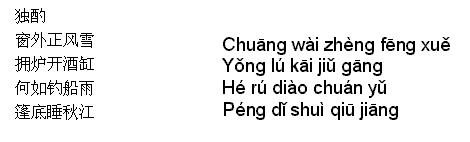
DRINKING ALONE


Wind blows snow straight across the window.
Curl around the stove, open the wine,
and, as a fishing boat in the rain,
Sail asleep down the autumn river. 


ON THE QINHUAI RIVER


With moonlight on sand and mist on cold water,
I tie up by a tavern on the river.
I hear a girl sing, with nothing of his grief,
the captive king's "Blossom of the Inner Court."


Well-made wine in autumn rain.
Cold house among fallen leaves.
The hermit who sleeps and sleeps
poured and drained cup after cup.
     --Du Mu


TRAVELLING IN THE MOUNTAINS


Far up the cold mountain, a sloping stone path.
Among the white colds, family dwellings.
Stop the carriage, loving evening in the maple wood.
Frosty leaves, redder than flowers of the second month.
     --Du Mu


DRUNKEN SLEEP


Autumn rain and well-made wine.
Cold house among falling leaves.
The hermit, who mostly sleeps,
pours and drains another cup.
     --Du Mu


YUAN ZHEN


SUMMER PALACE


Faded old travel palace.

Solitary red flowers.
Idle gray-haired ladies speak
of Emperor Li Long Ji.


ZU YOUNG


ON SEEING THE SNOW-PEAK OF ZHONGNAN MOUNTAIN


Beautiful, the north face of Zhongnan's peak,

piled-up snow above the floating clouds,
bright blue sky shining through the tree tops.
The city below colder with sunset.


WANG ZHIHUAN


Climbing Stork Tower


White sun sets against the mountains.
Yellow River flows to the sea.
To look out for a thousand miles,
you should go up one more story.


CLIMBING STORK TOWER--an alternate translation


White sun sets against blue mountain.
Brown river flows into green sea.
Aspiring to a broader view,
Huff and puff up the narrow stair.


The first translation adheres fairly closely to the literal meanings of the Chinese words.  In the second translation, I have attempted to achieve the antithetical parallelism of the two couplets by means of a technique called borrowed parallelism or "jiedui."  This technique involves constructing semantic parallels through wordplay with secondary meanings, that is, puns.   


QIAN QI


TO A JAPANESE MONK RETURNING HOME


Destined to come seeking the source in China.
Your voyage here was like a dream of distance,
floating between heaven and the vast green sea.
Now, the vessel goes lightly that carries the Way.
Water and moon are solitary as your Zen.
Fish and dragons absorb the sound of your chanting.
The single lamp of your compassion, its light
returns to watchers at the heart of the world.


LIU CHANGQING


TO SOUTH CREEK SEEKING DAO MAN CHANG IN HIS SECRET PLACE


All along the single path,
footprints in strawberry moss.
White clouds over quiet islands.
Spring grass latching the idle gate.
After rain, the look of the pines.
Up the mountain, the river’s source.
Sitting Zen in flowers by the creek.
Face to face, I forget what to say.


LIU YUXI


Grasses grow rank around Red Bird Bridge.
Sun sets in the street of mansions.
Swallows from peeling painted eaves
swoop across the doorways of common folk.